Summary: We're Not Afraid to Die...if We Can All Be Together


Key Points of the Story
- We're Not Afraid to Die... if We Can All Be Together is a true story of a family's sea journey.
- The narrator sails with his wife Mary, children Jonathan and Suzanne, and two sailors on the boat Wavewalker.
- They begin their journey from Plymouth in July 1976 to follow Captain James Cook's route.
- The voyage is pleasant till Cape Town, after which they face severe storms in the Southern Indian Ocean.
- A huge wave damages the ship badly and puts everyone in danger.
- Through courage, unity, and hard work, they save the ship and safely reach Île Amsterdam with the help of the islanders.
Detailed Summary
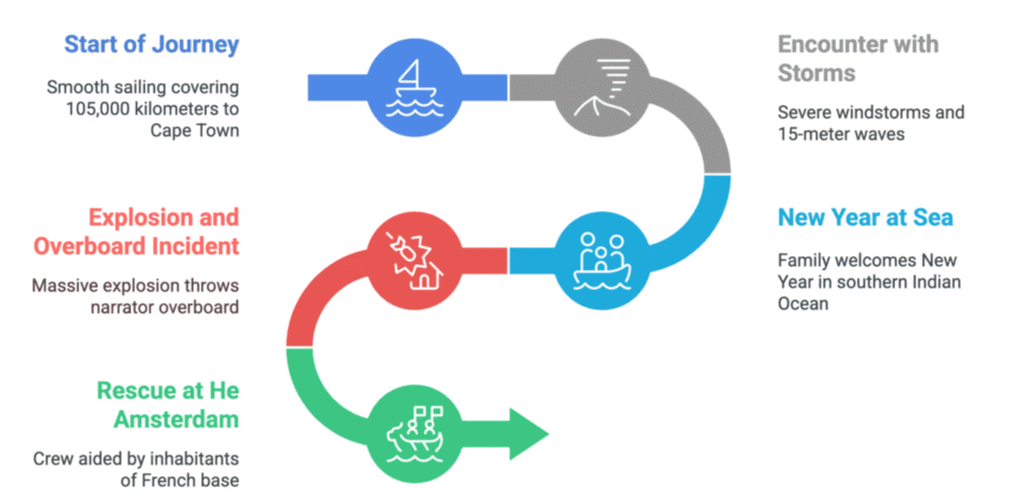
The narrative begins with a confident, adventurous mood. In July 1976 the family-father (the narrator), mother Mary, son Jonathan and daughter Suzanne-left Plymouth in the yacht Wavewalker along with two professional seamen, Larry Vigil and Herb Seigler. Their aim was to retrace a round-the-world voyage, following the spirit of Captain James Cook. The initial portion of the voyage was pleasant and covered a very large distance up to Cape Town, where they celebrated the first stage of their successful crossing.
After leaving Cape Town the weather changed. The writer describes the Southern Ocean as one of the most violent and unforgiving stretches of water on Earth. On 25 December they were still far out in the southern Indian Ocean and they welcomed the New Year there. On 2 January, conditions became catastrophic. The sea rose in enormous walls of water and gale-force winds battered the yacht. A violent explosion at about 6 p.m. threw the narrator overboard briefly and caused significant structural damage to the boat. The Wavewalker nearly capsized, huge waves smashed the deck and the vessel began to take on water through broken timbers and ripped hatch covers.
In the immediate aftermath the crew acted quickly and with great presence of mind. Although Suzanne suffered a serious head injury and Jonathan was hurt, everyone worked to improvise repairs. They lashed planks and canvas over smashed areas, tried to plug leaks, and used all available pumps to remove water. They lashed themselves to the yacht with lifelines, secured equipment, and kept watch in rotation to prevent being swept away. Radio Mayday calls were sent repeatedly in the hope that some vessel or shore station might hear them.
The narrative emphasises not only the technical measures of survival but the emotional resolve. The family's repeated words-"we're not afraid to die if we can all be together"-capture the moral and emotional choice they make: to face the greatest danger united rather than trying to save individuals at the cost of others. Through endurance, skillful improvisation and the unbroken unity of the party they succeeded in keeping the yacht afloat long enough to make progress toward safety.
After many hours and a desperate struggle against the elements and progressive damage to the hull and rigging, the survivors sighted land and were able to reach the small, remote French scientific base on Île Amsterdam. There the island's inhabitants-twenty-eight in number-rendered immediate aid. Their help enabled the injured to receive treatment and the Wavewalker to be assessed. Thus the voyage, which had descended into crisis, ended with rescue and the survivors' recovery.
Characters and Roles
- The narrator - the writer and skipper who leads the family and manages survival efforts after the explosion.
- Mary - the narrator's wife; shares the voyage and the emotional burden of the crisis.
- Jonathan - the son; sustains injuries but shows courage.
- Suzanne - the daughter; also seriously injured, yet displays remarkable bravery.
- Larry Vigil - an experienced American seaman who assists with sailing and emergency work.
- Herb Seigler - a Swiss professional seaman who helps handle technical and repair tasks.
- Residents of Île Amsterdam - the French base personnel and island inhabitants who provide final rescue and medical assistance.
Major Themes
- Family and Unity: The central affirmation "we're not afraid to die if we can all be together" expresses the priority of collective survival and mutual care over self-preservation at all costs. The unity of the family and crew becomes their moral strength.
- Courage and Determination: The story celebrates quiet courage, endurance and the will to act under extreme conditions. Courage here is practical as well as moral: making decisions, improvising repairs, and working through exhaustion.
- Human versus Nature: The sea is portrayed as immense, indifferent and violent. The narrative explores human vulnerability in face of nature's power and how human skill and resolve can still make survival possible.
- Seamanship and Preparedness: Knowledge of sails, rigging, pumps and emergency procedures, along with disciplined drills, proves crucial. Practical preparation and calm improvisation are decisive in survival.
- Hope and Rescue: Despite the bleak situation, the story affirms that skillful action, radio distress calls and eventual help from others can bring rescue even in remote oceans.
Difficult Words
- honing - improving, sharpening
- seafaring - travelling or working at sea
- hull - the main body or lower part of a ship
- atrocious - extremely bad or violent
- reasoned - thought carefully and logically
- jib - a triangular sail set forward of the mast
- knots - a unit of speed used at sea
- lashed - tied or fastened tightly
- stern - the back part of a ship
- impending - about to happen
- ominous (implied through context) - threatening or frightening
- aft - at the rear of a ship
- crest - the top of a wave
- torrent - a powerful rushing stream
- capsizing - overturning of a vessel
- taut - tightly stretched
- lifeline - a rope used for safety
- rag doll - a metaphor for helpless, loose movement
- ribs - curved timbers forming the ship's framework
- scrambled - moved quickly with difficulty
- hatch - an opening in a ship's deck
- starboard - the right side of a ship
- bulged - swollen outward
- sloshed - moved with splashing sounds
- canvas - strong waterproof cloth
- gaping - wide open
- debris - scattered broken pieces
- wrenched - twisted or pulled off forcefully
- dinghies - small boats carried on ships
- chartroom - room where navigation charts are kept
- Mayday calls - international distress signals
- pinpricks - tiny points; small islands in a vast sea
- abated - became less severe
- auxiliary - additional or backup
- rigging - ropes and chains supporting masts and sails
- respite - short period of relief
- deteriorate - grow worse
- heave-to - stop a ship safely in rough seas
- improvise - manage using available resources
- rode out - survived a storm
- sextant - instrument for navigation
- drift - movement caused by currents
- caricature - exaggerated drawing
- variation - difference in compass direction
- conviction - firm belief
- tousled - untidy or dishevelled
- chorused - spoke together
- stark - bare or severe
- bleak - cold, empty, lifeless
- direst - most extreme or terrible
- recurring - happening again and again
- clot - thickened mass of blood
Conclusion
The story is a moving record of human courage, the value of preparation and the moral priority of togetherness. Faced with a near-catastrophic storm, the family and crew rely on seamanship, improvisation and mutual care to survive. Their repeated affirmation-"we're not afraid to die if we can all be together"-is both a statement of love and a practical decision that sustains their discipline and co-operation. The final rescue at Île Amsterdam underlines that endurance, skill and solidarity can overcome even the direst of natural forces.
FAQs on Summary: We're Not Afraid to Die...if We Can All Be Together
| 1. What is the main story of "We're Not Afraid to Die...if We Can All Be Together" and why does the title matter? |  |
| 2. Who are the main characters in this CBSE Class 11 chapter and what roles do they play during the crisis? | |
| 3. What challenges does the family face on their journey and how do they overcome them? | |
| 4. How does the author use descriptive language to convey the danger and intensity of the storm? | |
| 5. What is the significance of human courage and family unity as themes in this survival account? | |